Showing posts with label Taita Hills. Show all posts

Mar 19, 2018

Rie Jensen's MSc thesis on Taita apalis foraging

One of the possible causes of the steady decline of Taita apalis (it decreased by 50-70% in the last 15 years) is that some change in the availabilty of its preferred food might have occurred inside its tiny range.

Rie Jensen, a Danish student from Copenhagen University, visited the Taita hills during the 2016-2017 breeding season to study Taita apalis' foraging in different forest fragments. Rie's work was supervised by Professor Anders P. Tøttrup and by me.

Rie (second from left in the photo) has recently successfully defended her thesis, and is now working on publishing her results. Congratulations, we all look forward to reading the very intersting papers that she will publish!

One short synopsis of Rie's work can be found here


Feb 28, 2018

One step closer to extinction

Journalist Rupi Mangat tells about Taita apalis and how it is now one step closer ot extinction

http://www.theeastafrican.co.ke/magazine/434746-4312846-1iru85/index.html

Mar 1, 2015

Teaching Conservation in the Taita Hills

Taita apalis survives in just 3 small forests and nowhere else!
The Taita hills in southern Kenya are one of the key area for the conservation of biodiversity in East Africa. Many species are endemic to these small mountains - that is, they only exist here and nowhere else in the world. Some species, such as the Taita apalis and the Taita thrush are restricted to a range of less than 500 hectares, which is more or less the same area as Central Park in New York. This is an extremely tiny range! For these reason, the IUCN and BirdLife International consider these two birds "Critically Endangered" which means an extremely high risk of extinction within less than 10 years.

Lawrence leading primary school pupils in the Taita forest
For many years, we have been involved in research and conservation activities in the Taita Hills. One of the key goals in conservation is increasing awareness, that is, making everybody know about the importance of conserving biodiversity. We must conserve it because these unique species are the common heritage of the entire world, and if we loose them, nobody will be able to to resurrect them.

Lawrence Wagura, one of the members of the Taita hills team, has been very active in teaching about conservation in primary and secondary schools in the Taita hills.

With support from the African Bird Club, Lawrence has recently embarked in an ambitious project that has involved more than 700 pupils from primary and secondary schools in the Taita. Lawrence visited the schools, and taught the students about biodiversity,, first in the classrooms, and then in the field, leading the students in a walk through some of the most interesting forests of the Taita hills. The students have been able to hear about the endemic birds, insects, plants and herps, and have even been able to see some of them with their eyes. For many of them, it was the first time, even though they all live in the Taita hills!

You can read more about Lawrence's project here.


Sep 18, 2014

A guide to the Wildlife and Natural History of the Taita Hills

Lawrence Wagura, who has been one of our field assistants and collaborators for long time, has just published a new guide to the Natural History of the Taita hills. Printing of the initial copies of the book was supported by BirdLife Africa Partnership Secretariat and Nature Kenya (BirdLife Partner) as part of a project funded by the Critical Ecosystem Partnership Fund (CEPF).

This is the first published guide for this important site. In simple language, backed up by colourful pictures, Lawrence comprehensively describes the site: he includes, among other topics, its history, geography, value, indigenous culture, and various types of plants and animals found there.
The book is not only useful for visitors and researchers; Lawrence also intends to use it as a tool for educating the youth and other residents of the Taita Hills on the value of conserving the site.

“With support from teachers, I have already been giving talks in schools in the area and I often take students for educational trips to the forests. I will now distribute free copies of the book to the schools, and in future use them for my educational talks”, says Lawrence. Lawrence hopes that the book will also encourage tourists who venture into the lower Tsavo plains and other areas to include a visit to the Taita. The booklet is now available for sale at Nature Kenya's offices in Nairobi and will of course also be distributed in the Taita Hills.


Aug 23, 2014

Another bad year for Taita apalis

We have just received data from this year's monitoring and, as it appears, this was another really bad year for Taita apalis.

Standardized counts show that numbers went down by about 50% since 2013 in the species' main stronghold - Ngangao forest. Putting the records on a map shows it clearly: between 2001 and 2014, the decrement is in the order of 90%. At this rate, the extinction of the species in Ngangao might be no more than one or two years away.

Ngangao used to host more than 60% of the global population no more than ten years ago.

Things are not going better in the other forest fragments where the species occurs - we obtained no records from Chawia, Fururu and Mbololo for more than two years. We suspect that  Taita apalis is now very rare or even locally extinct in these forest fragments.

Only Msidunyi and Vuria, the two fragments located at the highest elevations, have relatively stable numbers in the last years. But the area of these two forests is tiny: little more than 100ha of suitable habitat remains there.

Our research continues to identify the causes of the so far unstoppable decline. We already know that some apalis territories were lost along forest edges due to direct human disturbance, but the story is more complicated, because we noticed severe declines even in the best preserved, and apparently undisturbed, parts of the forest. It is a race against time, and the clock is ticking fast.

Acknowledgments: We thank RSPB for funding this work.
Records of Taita apalis in Ngangao forest, the species' main stronghold


Nov 20, 2013

A new population of Taita apalis discovered - but deforestation will soon wipe it out

There might be less than 300 Taita apalis left - an incredibly small population. This unique species lives only on top of the highest peaks in the Taita hills of southern Kenya.

A male Taita apalis
With such a tiny number of individuals involved, the discovery of a new population of Taita apalis makes a huge news - even if it consists of just 8 pairs!

In October 2011, we discovered a new patch of forest in a site called Msidunyi, in the eastern part of the Taita Hills, and we observed a small number of Taita apalis in the forest.

Field work during 2012 and 2013, supported by a grant of the Conservation Fund of the African Bird Club, has enabled us to precisely map the territories of the 8 pairs of Taita apalis in Msidunyi. These are shown by the red lines and dots in the map below. As tiny as it might look, the population of Taita apalis in Msidunyi might represent as much as 5-10% of the individuals of the species.

Apalis territories in Msidunyi
 But as we struggle to map the few apalis territories in Msidunyi, deforestation progresses. The human population in Taita is growing fast, and as more people are added, more land is converted in to crops. In the two years that elapsed from our initial discovery to now, almost 20% if the indigenous vegetation in Msidunyi has been damaged or converted. Soon, little will be left there to protect.

Cut logs in Msidunyi, October 2012

Oct 31, 2013

Invasion!

A Bar-throated apalis in the Taita hills (February 2013). Notice the differences between this species and the Taita apalis


If things were not bad enough for our little friend, the Taita apalis, our recent observations show that the situation is getting even worse.

The Taita apalis is one of the world's rarest birds. It only lives in seven small bits of forest, in the Taita Hills of Southern Kenya. Deforestation in the Taita hills has been savage, and currently no more than 500 ha of forest remain - an area more of less of the same size of Central Park in New York!

Our work already showed that there are probably less than 500 individuals of Taita apalis surviving. But the really bad news is that their range is being invaded by another species, the Bar-throated apalis. The Bar-throated apalis had never been observed in the Taita hills in the past, but in the last year, we have spotted individuals of this species with increasing frequency.

Bar-throated and Taita apalis are closely related, and hybridization between the two is likely to occur. If that will happen, the genetic integrity of Taita apalis might be lost, and the species might rapidly disappear.

We don't know the origin of the Bar-throated apalis invaders that we have observed repeatedly at several locations from the end of 2012 up to now. These birds might come from the West Usambara mountains (120km South of the Taita hills) or from the Chyulu hills (70 km West of the Taita).

We are monitoring the situation closely. Urgent issues to understand is how many pairs of Bar-throated apalis have invaded the Taita hills (so far we observed three, but there might be more), where do they originate, and most of all, if they are able to breed and hybridize with the Taita endemic species.

A male Taita apalis, notice the black throat and no bar on the breast

Sep 7, 2013

Forest still shrinking in the Taita hills

Lawrence Wagura, one of our students, is in the Taita hills, the last tiny refuge of Taita apalis, one of the rarest birds in the world. Together with Lawrence, and Kenyan ornithologist Mwangi Githiru, we have been working on this species for four years, trying to save its habitat and rescue its population, which we estimate to be between 200 to 300 individuals.

Unfortunately, as human population in the Taita hills increases fast, pressure on the last natural habitats grows. The Taita apalis is particularly at risk, because this species occurs in shrubby habitats along forest edges, which are often the places where cultivated fields encroach.

See below one photo I have just received from Lawrence. This site was occupied by one territory of Taita apalis no more than one year ago, but has been turned into cultivation now. With such a rare species as the Taita apalis, the loss of even a single nesting pair is causing a serious threat to the survival of the species. And this trend does not seem to ease down. Bad news for Taita apalis.

Taita apalis territory transformed into cultivation (photo L. Wagura)

Mar 10, 2013

A visit to the Taita Hills

Hello all!

Kenyan journalist Rupi Mangat joined us in our recent field trip to the Taita hills, where we are fighting to save the Taita apalis, a bird whose range is smaller than New York's Central Park and whose entire population is less than 150 pairs!

Rupi wrote an article for the East African Magazine, you can read it here


Oct 15, 2012

Nest of the Taita apalis discovered!

Lawrence Wagura, a student who is receiving one of our fellowships, is studying the Taita apalis, one of the rarest birds in the world. Its entire population is no more than 300 birds, living in seven small forests of just a few hectares each.
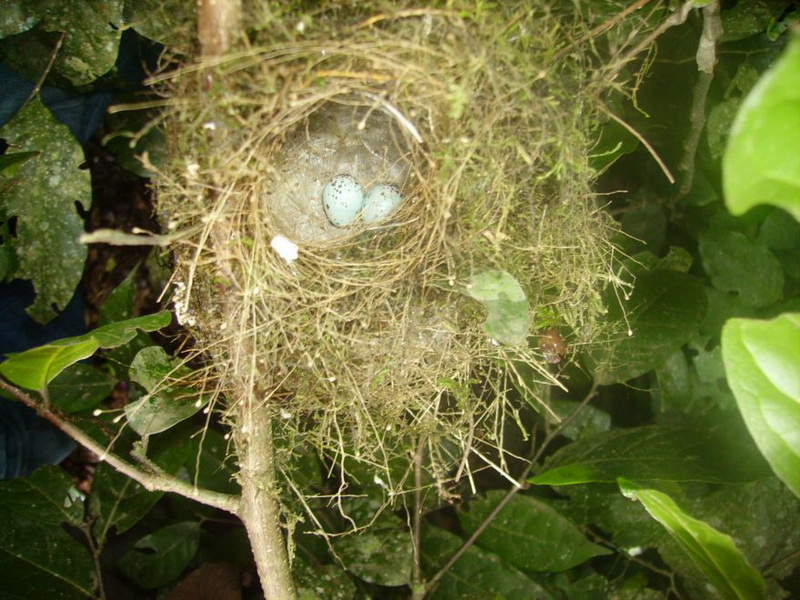
During his work in the forest, Lawrence discovered the apalis' nest - which had never been observed before. This is major step forward in saving this critically endangered species. A paper written by Lawrence has been published on a scientific journal (Bull ABC 18(1):42-46). Congratulations to Lawrence and keep up with the good work!

The apalis's nest, deep in the forest
A male Taita apalis
Lawrence and Dr Liv in the Taita Hills forest


Oct 12, 2011

A new forest discovered in the Taita Hills!

The Taita Hills of Kenya are a small range of mountains and a paradise of biodiversity. The forests in the Taita have evolved in isolation for perhaps 10 million of years, and evolution produced numerous species that can only be seen there and nowhere else in the world. One of these species is a small bird, the Taita apalis, whose population is reduced to just a few hundred individuals.
The Taita apalis, Apalis fuscigularis
Lawrence Wagura is one of the students that has been sponsored by our small fellowships. Lawrence works with the National Museums of Kenya, and is studying the details of the life history of the Taita apalis, which is a critically endangered species, because it is estimated that more than 95% of the original vegetation of the Taita has been lost. Currently less than 500 hectares of forest remain, scattered in twelve small fragments, some of which are less than one hectare in size. In September 2011, Lawrence and I, during a week of field work in the Taita, stumbled in a most astonishing and welcome discovery. A new forest, never visited by scientists in the Taita! The site, called Msidunyi by local people, escaped detection up to now as it is completely surrounded and hidden by a large plantation of non-indigenous trees. Msidunyi contains about 7.2 hectares of indigenous forest with few signs of human disturbance.

Lawrence birding in Msidunji, October 2011
Preliminary data suggest that Msidunyi is one of the biologically richest forest fragments of the Taita Hills, one of the most important findings was that of a new population of the Taita apalis. We do not know exactly how many individuals of the apalis might be in Msidunyi, but in any case this is a very important news for a bird whose entire population might be now less than 200 individuals! It is surprising that it escaped detection up to now considering that several biological surveys have been carried out in the area in the two decades. Based on size alone, Msidunyi is the sixth largest forest in the hills. More detailed biological surveys are needed to confirm the conservation value of this small forest patch, but the presence of a diverse flora and fauna, including endemic and globally threatened species, suggest that Msidunyi is an important refuge for rare species and a stepping stone for preserving biological connectivity between the isolated forest remnants of the Taita Hills.